


Blog
Omega Speedmaster Moonwatch


The Omega Speedmaster Moonwatch is in a class of its own. This famous stopwatch is a professional tool that has had a significant impact on history. It is loved here and in outer space. The Moonwatch is still a sign of trust, accuracy, and longevity, from NASA projects to today’s collectors. It still feels important, wanted, and moving even after many years.
The Omega Speedmaster Moonwatch is special because Omega has improved it without ruining what makes it unique. The new Speedmaster Moonwatch Professional keeps the 4th-generation design from its original release, but it also receives the Master Chronometer certification, a mark of current watchmaking quality. The Moonwatch is still seen as the standard for expert chronographs because it strikes a balance between the past and the present.
The Speedmaster Moonwatch Professional at a Glance
The current Speedmaster Moonwatch Professional has a 42 mm stainless steel case and comes with either a steel band or various straps. Depending on how it’s set up, the price usually falls between $7,400 and $9,100. The item is expensive because it is a high-end product, but its real value lies in its unique history and reputation for craftsmanship.
This isn’t a watch that was influenced by space history; it’s space history. Every current Moonwatch is designed to look like the ones once worn in space, making this watch unique for its historical consistency.
What is the Omega Speedmaster Moonwatch?
Astronauts wore the Omega Speedmaster Moonwatch, a 42 mm manual-wind stopwatch, during every Moon landing. It was the first watch worn on the Moon, and it is still one of the most historically significant watches ever made.
What Is the Omega Speedmaster Moonwatch Professional?
The Speedmaster Moonwatch Professional is a hand-wound Omega stopwatch. NASA granted it flight qualification in 1965, and it was worn on all Apollo flights, including Apollo 11, the critical mission.
The Moonwatch is history, not just a watch that talks about history. All current watches are based on the ones that astronauts wore. They kept the same case size, layout, and approach to ensure they worked. This consistency isn’t very common in modern watchmaking, which is a prominent reason collectors and fans think so highly of the Moonwatch.
The Origins of the Speedmaster (1957)
The Speedmaster was first introduced in 1957 as a speed chronograph. Putting the tachymeter ring on the outside of the dial was a groundbreaking design choice that made the watch easier to read and use. At this point, Omega was thinking about racing, not space.
But soon NASA would be interested in the watch’s readability, robustness, and accuracy, which made it perfect for racing. In the field of timekeeping, the Speedmaster’s shift from a tool for racetracks to one for space exploration is an interesting story.
NASA Testing
NASA put wristwatch candidates through extreme tests when they were looking for one for human missions. Some of these were high and low temperatures, shocks, shaking, exposure to a vacuum, and acceleration. A lot of watches broke quickly.
The Speedmaster was the only one to pass all of the tests. So, in 1965, it was officially designated “Flight Qualified” and launched on Gemini 3 just a few weeks later. This moment changed the watch’s future forever.
The Moon Landing That Changed Everything
Astronaut Buzz Aldrin walked on the moon wearing the Speedmaster on 20 July 1969. That one moment turned the watch from a business tool into a global symbol. From that point on, it was called the Moonwatch by everyone.
This wasn’t symbolic wear. The Speedmaster was widely used during missions. For example, it was used on Apollo 13 to time a significant engine burn that helped the crew get home safely.
Hesalite vs Sapphire Comparison
| Feature | Hesalite Crystal | Sapphire Crystal |
|---|---|---|
| Historical Accuracy | Exact match to Moon missions | Modern interpretation |
| Scratch Resistance | Lower (can be polished) | Very high |
| Dial Appearance | Warm, vintage feel | Crisp, clear |
| Caseback | Solid | Transparent |
| Best For | Purists & collectors | Daily wear & durability |
Design Elements That Define the Moonwatch
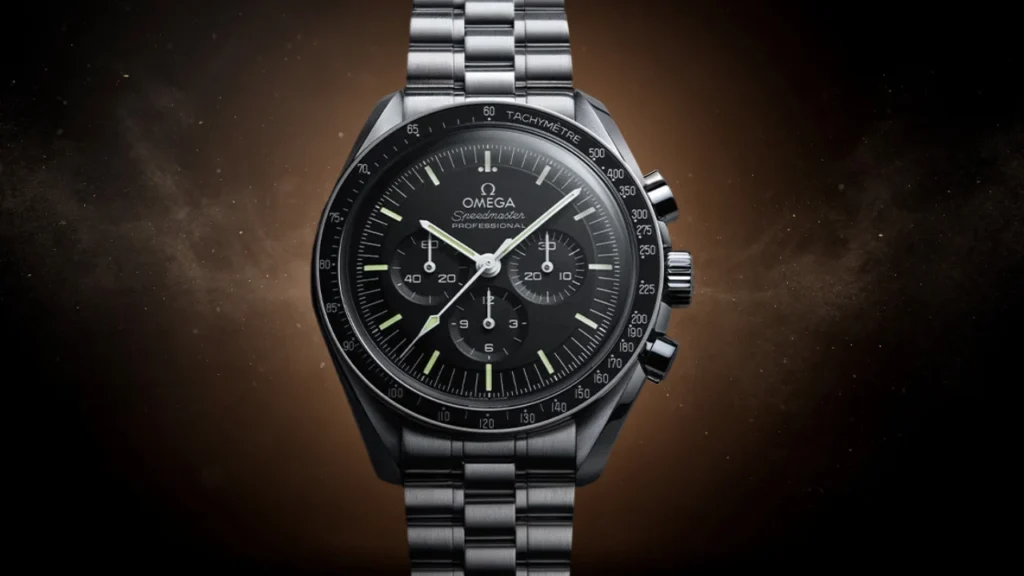
The Omega Speedmaster Moonwatch has four features that make it easily recognizable. Each one links today’s building techniques with designs from the past to create a watch that isn’t flashy but feels purposeful, balanced, and timeless.
The 42 mm Asymmetrical Case: Purposeful Design
The 42 mm stainless steel case of the Moonwatch has not changed much over the decades, and this is meant to be the case. The watch’s unique, professional look comes from its uneven shape, which was made to protect the crown and stopwatch pushers. This design wasn’t just made to look good; it was also made to survive challenging situations.
The case feels fine on the wrist, even though it’s big. It won’t feel heavy thanks to its well-balanced shape and twisted lugs. This makes it suitable for both daily wear and long-term use. It feels safe and solid, and it never gets in the way.
The Step Dial: Vintage Detail, Modern Execution
The return of the step scale is one of the most popular improvements in recent years. This slight rise around the dial adds depth to the watch and is a clear nod to older Moonwatch models. The black dial layout remains simple and easy to read, and the three subdials are perfectly balanced and accurate to the original design.
Omega also improved the minute track to match the rhythm of the modern movement. This change might look small, but it shows how carefully the Moonwatch has been updated—making it more technically correct while keeping its traditional identity.
Dot Over Ninety (DON): Why Collectors Care
The well-known Dot Over Ninety can be seen on the tachymeter ring. In this design, the dot is above the 90 instead of next to it. This little feature was on early Speedmasters and has become very popular with fans.
Its comeback is more than just a way to show love for the past. It’s a sign of Omega’s dedication to honoring the history behind the Moonwatch. Fans care about these details because they help maintain the watch’s realism, which makes it special.
Bracelet and Clasp: Comfort for Everyday Wear
The stainless steel band has been improved for greater comfort while retaining the tool-watch feel. At the clasp, it narrows to 15 mm, making it easier to wear and balance throughout the day. The built-in comfort adjustment lets you change the size without taking off the watch.
The Omega name on the clasp cover is satin-finished, so it looks classy without being too shiny. The outcome is a bracelet that is true to the professional nature of the Moonwatch but feels current and comfy.
Steel vs Gold Moonwatches: What’s the Difference?
If you’re looking for more than just steel luxury, Omega has Moonwatches in fine metals like Sedna™ Gold, Moonshine™ Gold, and Canopus Gold™.
Steel vs Gold Moonwatch Comparison
| Feature | Stainless Steel | 18K Gold Models |
|---|---|---|
| Weight | Lighter | Significantly heavier |
| Price Range | ~$7,400–$9,100 | Much higher |
| Aesthetic | Tool-watch heritage | High luxury |
| Wearability | Everyday use | Statement piece |
| Collector Appeal | Very high | Exclusive collectors |
Core Variations and Mechanical Heart of the Moonwatch
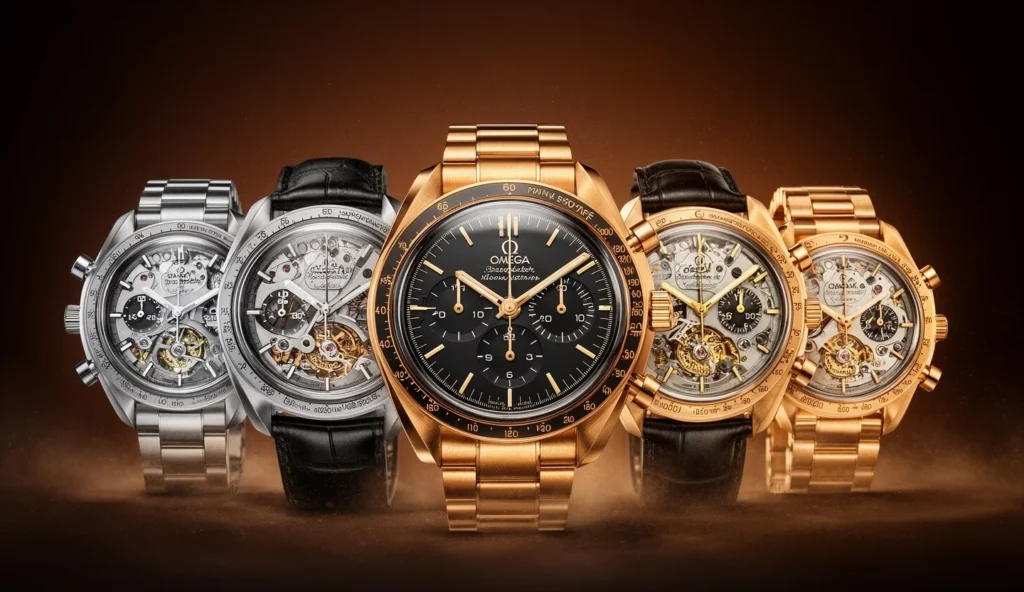
The Speedmaster Moonwatch looks like nothing has changed, but its new lineup and internal engineering show that smart decisions have been made to keep the history while boosting performance. Here’s how the Moonwatch stays real even though it doesn’t stay still.
The “Crew of Four” Steel Moonwatch Models
There are four basic steel types at the center of the Speedmaster Moonwatch Master Chronometer collection. These are not different watches at heart; they are well-thought-out versions of the same Moonwatch, made to suit different ways of wearing them rather than giving them new identities.
The Hesalite models most closely resemble the original space-qualified watches. They come with either a nylon strap or a thoroughly brushed stainless steel bracelet. The sapphire crystal versions have a more modern look and can be worn with a leather strap or a stainless steel band that mixes polished and brushed surfaces. The Moonwatch is still the Moonwatch, no matter what else is chosen.
Calibre 3861: The Modern Moonwatch Engine
The Omega Calibre 3861 is today’s Moonwatch’s most crucial part. It is a manual-wind movement that can be traced straight back to the first Speedmaster worn on the Moon. The building is a mix of old-fashioned style and new technology.
The movement runs at 3 Hz, allowing it to keep time reliably. It also has a 50-hour power backup, so it will keep running even when it’s not connected to a power source. Its Co-Axial escapement makes it more reliable over the long term, and its Master Chronometer status guarantees excellent accuracy and resistance to magnetic fields up to 15,000 gauss. Because of this, the Calibre 3861 is both historically correct and technically modern.
Why the Moonwatch Is Still Manual-Wind
In a time when automatic movements are most popular, the Moonwatch is still manual-wind because that is the choice of its makers. This isn’t a compromise; it’s a continuation of the way of thinking that made it worthy of going into space in the first place. NASA first approved the Speedmaster because its manual-wind movement is mechanically simpler, more robust, and more reliable in extreme situations.
Hand-winding the watch also sets up a daily routine. It strengthens the link between the person wearing it and the mechanism, turning the Moonwatch from a passive object into an active experience rooted in its past and purpose.
Is the Omega Speedmaster Moonwatch Worth the Price?
Yes, if you care about history, authenticity, and classic style. The Moonwatch has a story that no other watch can copy. It keeps its value well and is always in demand.
It’s not about excitement or trends. It’s about having something that lasts in a world where things are thrown away.
FAQs about Omega Speedmaster Moonwatch
Does Omega Speedmaster Moonwatch hold value?
Yes, the Moonwatch maintains its value because it is historically significant, has few variations, and is in high demand.
How much is an Omega Speedmaster Moonwatch?
For steel models, the prices usually run from $7,400 to $9,100. Gold or limited editions cost a lot more.
Is a Speedmaster Moonwatch a good investment?
Yes, it is an excellent collectible because it has a fascinating history, people always want it, and it sells for about the same price it costs.
Why is it called a Moonwatch?
It was the first watch worn on the Moon during NASA’s Apollo flights.
Why did NASA choose Omega over Rolex?
Omega passed NASA’s extreme spaceflight tests, demonstrating that it was the most reliable watch brand under harsh conditions. Rolex, on the other hand, did not.
How do you spot a fake Moonwatch?
Check the Dot Over Ninety bezel, the weight, the high-quality finish, the proper case markings, and the movement itself (Calibre 3861 for modern models); if anything is off, it’s probably a fake.